
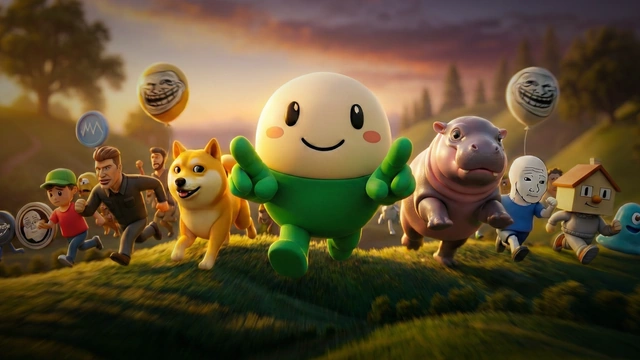


In July 2009, an anonymous 4chan user posted a stripped-down version of a cartoon character on /b/ (and associated boards) with the challenge “Post ending in 69 names this meme!!!” The reply whose ID ended in 69 simply typed “fsjal.” That accidental string became the official name of one of the era’s most prolific drawing fads. The figure itself traces to a March 2008 DeviantArt comic by Brian Lee (“BROTERSTORY”), in which Toon Link appears with bent arms and eyes rolled upward in excitement. What began as a single panel rapidly mutated into an open template. Users redrew virtually any character, object, or celebrity in the same crude style: stubby limbs, oversized head, fists clenched in anticipation, eyes fixed upward. The result was not a single joke but a flexible visual language of hype, impatience, and childlike eagerness. This thesis treats fsjal not as a disposable forced meme but as a durable piece of digital folklore whose mechanics reveal how internet communities generate, name, and preserve cultural forms.
Position
$1.36
Profit
−$0.20(13.0%)
Avg entry
$40.9K MCHolding
Conclusion Fsjal is more than a random string attached to a wide-eyed cartoon. It is a compact demonstration of how digital folklore operates: an affective gesture is isolated, a name is assigned by lottery, a template is released into the wild, and a community keeps producing instances until the form acquires historical weight. The meme’s endurance—and its recent financialization—shows that the internet’s earliest participatory experiments continue to structure how online groups generate meaning, even when that meaning begins as pure noise. The clenched fists and upward eyes remain ready. Whatever arrives next, fsjal is already waiting.